
The Role of Conjunctions in Complex Sentences – English Grammar Guide
The Role of Conjunctions in Complex Sentences
Conjunctions are the glue that hold ideas together in a sentence. When writing or speaking in English, using conjunctions correctly can help you form more advanced and meaningful thoughts. In this article, we’ll explore what conjunctions are, how they function in complex sentences, and how you can use them effectively.
What is a Conjunction?
A conjunction is a word used to connect clauses, sentences, or words. In complex sentences, conjunctions are especially important because they connect an independent clause with one or more dependent clauses.
What Is a Complex Sentence?
A complex sentence contains one independent clause (a complete sentence) and at least one dependent clause (a group of words that can’t stand alone). Conjunctions are used to join these parts.
Types of Conjunctions
There are three main types of conjunctions:
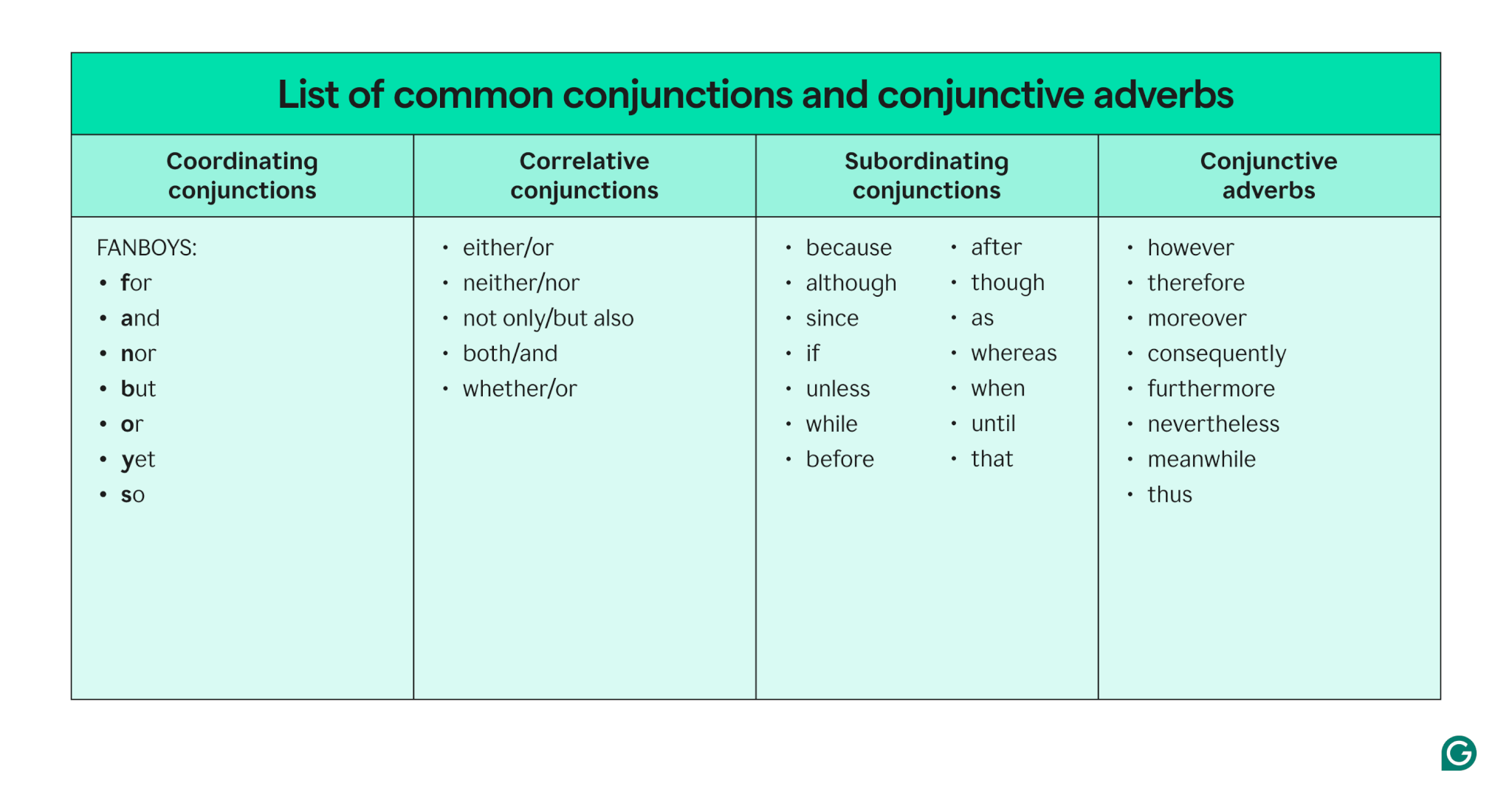
- Coordinating conjunctions – connect words or independent clauses (e.g., and, but, or)
- Subordinating conjunctions – connect a dependent clause to an independent clause (e.g., because, although, while)
- Correlative conjunctions – come in pairs (e.g., either…or, neither…nor)
Focus: Subordinating Conjunctions in Complex Sentences
In complex sentences, we usually use subordinating conjunctions to show the relationship between the clauses. These conjunctions can indicate time, cause and effect, contrast, condition, and more.
| Conjunction | Type of Relationship | Example |
|---|---|---|
| Because | Cause and Effect | She stayed home because she was sick. |
| Although | Contrast | Although it was raining, we went outside. |
| While | Time / Contrast | While he was cooking, she was watching TV. |
| If | Condition | We’ll go if it doesn’t rain. |
| Since | Cause / Time | Since you’re here, let’s start. |
How to Form a Complex Sentence
Here’s a simple formula for building a complex sentence:
Independent Clause + Subordinating Conjunction + Dependent Clause
Example: I didn’t go to the party because I was tired.
Or reverse the order:
Subordinating Conjunction + Dependent Clause + , + Independent Clause
Example: Because I was tired, I didn’t go to the party.
Tips for Using Conjunctions Effectively
- Don’t use too many conjunctions in one sentence.
- Start small: use one conjunction per sentence as you learn.
- Use a comma when the dependent clause comes first.
- Practice rewriting simple sentences into complex ones.
Practice Examples
- Although he tried hard, he failed the test.
- She passed the test because she studied well.
- If you call me, I’ll explain everything.
- Since it’s late, let’s stop here.
- We waited until the rain stopped.
FAQs
Q1: What is the most common conjunction in complex sentences?
A: "Because" is one of the most commonly used subordinating conjunctions in complex sentences.
Q2: Can a sentence have more than one conjunction?
A: Yes, but using too many can make the sentence confusing. Keep it simple unless you’re confident.
Q3: Do all conjunctions require a comma?
A: Not all. Use a comma only when the dependent clause comes before the independent clause.
Conclusion
Conjunctions are powerful tools that make your English more expressive and fluent. By learning how to use them in complex sentences, you can link ideas, show relationships, and add depth to your writing and speaking. Keep practicing, and soon, using conjunctions will become second nature!
Popular Posts
30 Nature Words You Should Know – Expand Your Environmental Vocabulary
Word Lists & Themes
100 Descriptive Adjectives for Writers to Enhance Storytelling
Word Lists & Themes
Top 20 Business English Words You’ll Hear in Meetings
Word Lists & Themes
Vocabulary for Emotions – Words Beyond “Happy” and “Sad”
Word Lists & Themes
50 Powerful English Words to Improve Your Vocabulary
Word Lists & Themes
Transitive vs. Intransitive Verbs – Simple Grammar Explanation
Grammar in Context