
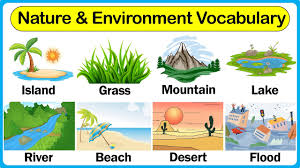
30 Nature Words You Should Know – Expand Your Environmental Vocabulary
30 Nature Words You Should Know
Nature is full of beauty, mystery, and inspiration. To describe it better, we need more than just words like “tree,” “sky,” or “river.” This article introduces 30 beautiful and unique English nature-related words that will enrich your vocabulary and help you speak or write more expressively about the environment.
???? Top 30 Nature Words with Meanings
- Meadow – A field of grass and wildflowers.
- Canopy – The upper layer of branches and leaves in a forest.
- Brook – A small, flowing stream of water.
- Gale – A strong wind, often used when describing storms.
- Creek – A small river or stream, especially in rural areas.
- Blossom – A flower or the process of flowering.
- Glade – An open space in a forest.
- Foothill – A low hill at the base of a mountain range.
- Mist – A light fog, usually seen in the morning or near water.
- Dune – A hill of sand created by wind, typically found in deserts or beaches.
- Horizon – The line where the earth or sea meets the sky.
- Ridge – A long, narrow hilltop or mountain top.
- Lagoon – A shallow body of water separated from a larger sea or ocean.
- Rainforest – A dense forest with high rainfall, home to many species.
- Tide – The rise and fall of sea levels caused by the moon’s gravity.
- Sprout – A new shoot or bud growing from a plant.
- Petal – A part of a flower, usually colorful and delicate.
- Foliage – The leaves of a plant or tree.
- Whirlwind – A fast, spinning wind that moves in circles.
- Valley – A low area of land between hills or mountains.
- Drizzle – Light rain with small drops.
- Crag – A steep, rugged rock or cliff.
- Peat – A type of soil made of decayed plant matter, often found in bogs.
- Rustle – A soft sound made by leaves or grass moving in the wind.
- Thicket – A dense group of bushes or small trees.
- Geyser – A hot spring that sprays water into the air.
- Ripple – A small wave or movement on the surface of water.
- Shoreline – The edge where land meets water, like a beach or lakefront.
- Marsh – A wetland with soft, muddy ground and grasses.
- Ember – A glowing piece of coal or wood in a fire.
???? Why Learn Nature Words?
- Better Expression: These words help you describe natural beauty in a more vivid way.
- Creative Writing: Writers and poets often use nature words to create mood and atmosphere.
- IELTS/TOEFL: A rich vocabulary helps in exams where descriptive writing or speaking is required.
- Environmental Awareness: Knowing the terms helps you understand nature-related topics and discussions.
???? Example Sentences
- We walked through a peaceful meadow filled with blooming flowers.
- Morning mist covered the lake, giving it a magical look.
- The canopy of the rainforest blocks most sunlight from reaching the ground.
- Waves created gentle ripples on the ocean’s surface.
???? Conclusion
Nature is full of wonder, and the English language offers many beautiful words to describe it. Learn and use these 30 nature-related words to make your conversations, essays, or creative writing more engaging and vivid. You’ll not only impress others with your vocabulary but also develop a deeper connection to the natural world around you.
? FAQs
1. Are these nature words used in daily conversation?
Yes! Words like “meadow,” “drizzle,” “brook,” and “valley” are commonly used in both spoken and written English.
2. How can I remember these words better?
Use flashcards, associate each word with a picture, or practice writing short nature descriptions using these terms.
3. Are these words helpful for IELTS or TOEFL?
Absolutely. They can improve your descriptive writing and help you score higher in speaking and writing tests.
4. Can I get a version with Urdu meanings?
Yes! Just let me know, and I can provide the Urdu translation of each word for better understanding.
Popular Posts
30 Nature Words You Should Know – Expand Your Environmental Vocabulary
Word Lists & Themes
100 Descriptive Adjectives for Writers to Enhance Storytelling
Word Lists & Themes
Top 20 Business English Words You’ll Hear in Meetings
Word Lists & Themes
Vocabulary for Emotions – Words Beyond “Happy” and “Sad”
Word Lists & Themes
50 Powerful English Words to Improve Your Vocabulary
Word Lists & Themes
Transitive vs. Intransitive Verbs – Simple Grammar Explanation
Grammar in Context