
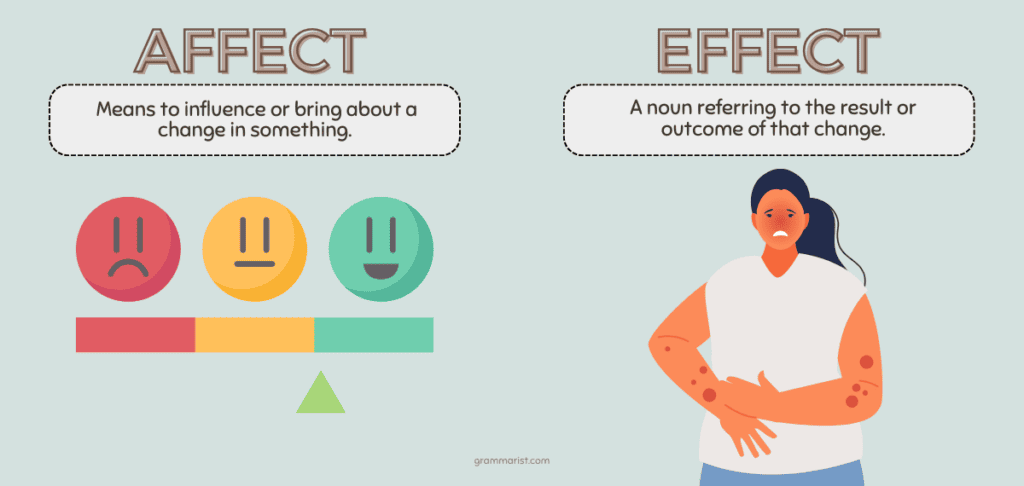
Affect vs. Effect – Key Differences with Examples
“Affect” vs. “Effect” – Learn the Difference
Many English learners — and even native speakers — struggle with when to use “affect” vs. “effect.” These two words sound similar but play very different roles in a sentence. Let’s break it down in a simple and easy way with definitions, examples, and tips!
Quick Answer
Affect is usually a verb (an action word) meaning to influence or change something.
Effect is usually a noun meaning the result or outcome of something.
What Does “Affect” Mean?
Affect (verb) means to influence or to cause a change.
Examples:
- The bad weather affected our travel plans.
- Stress can affect your health.
- Her speech affected the audience deeply.
What Does “Effect” Mean?
Effect (noun) means the result or outcome of an action.
Examples:
- The new law had a positive effect on the economy.
- The medicine had side effects.
- Lack of sleep has a bad effect on your focus.
How to Remember the Difference
- Affect = Action (A for Action, A for Affect)
- Effect = rEsult (E for End result, E for Effect)
Examples in One Sentence
The weather affected the game, and the effect was a delay.
Exceptions to the Rule
Sometimes “effect” is used as a verb (to bring about), and “affect” can be used as a noun in psychology — but those are rare and more advanced uses.
Example (rare use of “effect” as a verb):
The president hopes to effect change in the education system. (Here, "effect" means to cause or bring about.)
Common Mistakes to Avoid
- ? The new policy will effect your salary. → ? affect
- ? The weather had a bad affect. → ? effect
Practice Quiz
Fill in the blanks:
- Too much sugar can ______ your health.
- The new rule had a strong ______ on students.
- Her attitude ______ everyone at work.
Answers: 1. affect 2. effect 3. affected
Conclusion
In summary, remember:
- Affect = Verb = Action
- Effect = Noun = Result
Keep practicing with real-life examples and soon you’ll never mix up “affect” and “effect” again!
FAQs
Q1: Is “effect” ever a verb?
Yes, rarely. “To effect” means to bring about, like “to effect change.” But this is formal and not common in daily English.
Q2: What’s the most common use of “affect”?
As a verb meaning “to influence” or “to have an impact on.”
Q3: Can I use “affect” as a noun?
Yes, in psychology. For example, “His facial affect was flat,” but this is technical and used mainly by professionals.
Q4: What’s a quick tip to remember the difference?
Affect is an Action (both start with A), and Effect is an End result (both start with E).
Popular Posts
30 Nature Words You Should Know – Expand Your Environmental Vocabulary
Word Lists & Themes

100 Descriptive Adjectives for Writers to Enhance Storytelling
Word Lists & Themes

Top 20 Business English Words You’ll Hear in Meetings
Word Lists & Themes
Vocabulary for Emotions – Words Beyond “Happy” and “Sad”
Word Lists & Themes
50 Powerful English Words to Improve Your Vocabulary
Word Lists & Themes
Transitive vs. Intransitive Verbs – Simple Grammar Explanation
Grammar in Context