
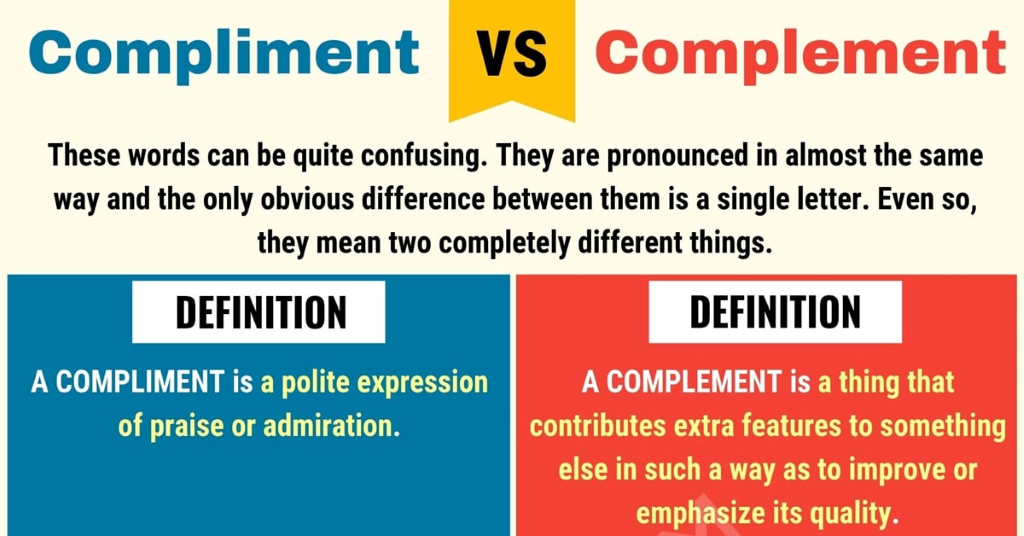
Compliment vs. Complement – What’s the Difference?
Compliment vs. Complement – What’s the Difference?
Have you ever paused while writing, unsure whether to use “compliment” or “complement”? You’re not alone! These two words sound nearly identical but have very different meanings and uses. Let’s clear up the confusion once and for all.
What Does “Compliment” Mean?
The word “compliment” refers to a polite expression of praise or admiration. It can be used as both a noun and a verb.
Examples:
- She gave me a nice compliment on my outfit.
- I want to compliment you on your excellent work!
So, if someone says something kind or nice about you, they’re giving you a compliment.
What Does “Complement” Mean?
On the other hand, “complement” means something that completes or enhances another thing. It often refers to items, styles, or colors that go well together.
Examples:
- Her red lipstick perfectly complements her dress.
- These two ingredients complement each other in flavor.
If two things complement each other, they work together harmoniously or improve each other.
How to Remember the Difference
- Compliment = Praise (think “i” for “I like it”)
- Complement = Completes (think “e” for “enhance”)
This simple trick helps many people remember which one to use.
Usage in Daily Conversation
Correct Usage of “Compliment”:
- He complimented her on her presentation skills.
- I received a lovely compliment from my boss today.
Correct Usage of “Complement”:
- The scarf complements the jacket beautifully.
- This wine complements the cheese platter.
Common Mistakes to Avoid
- Incorrect: He complemented her on her dress.
- Correct: He complimented her on her dress.
- Incorrect: The sauce is a great compliment to the dish.
- Correct: The sauce is a great complement to the dish.
Wrap-Up: When to Use Each Word
| Word | Meaning | Use in Sentence |
|---|---|---|
| Compliment | A kind or flattering remark | She gave me a nice compliment. |
| Complement | Something that goes well with something else | The shoes complement her outfit. |
Conclusion
Don’t let similar-sounding words trip you up! Knowing the difference between “compliment” and “complement” will not only make your writing more polished but also help you avoid embarrassing mix-ups.
Whenever you’re unsure, think about whether you're giving praise (compliment) or describing something that enhances (complement). Easy!
FAQs
1. Can “compliment” be used in a professional email?
Absolutely! Saying “I wanted to compliment your recent presentation” is perfectly polite and professional.
2. Is it okay to say “complement each other” about people?
Yes! You can say two people complement each other if they balance each other well.
3. Are these words interchangeable?
No. They sound similar but have different meanings and should not be swapped.
4. What is a good way to remember the difference?
Remember: “Compliment” has an “i” like in “I like your hair!” while “complement” has an “e” like in “enhance.”
5. Do these words have other meanings?
“Complement” can also be used in mathematics or as a military term, but those uses are less common in daily English.
Popular Posts

30 Nature Words You Should Know – Expand Your Environmental Vocabulary
Word Lists & Themes
100 Descriptive Adjectives for Writers to Enhance Storytelling
Word Lists & Themes

Top 20 Business English Words You’ll Hear in Meetings
Word Lists & Themes
Vocabulary for Emotions – Words Beyond “Happy” and “Sad”
Word Lists & Themes
50 Powerful English Words to Improve Your Vocabulary
Word Lists & Themes
Transitive vs. Intransitive Verbs – Simple Grammar Explanation
Grammar in Context